Showing posts with label science. Show all posts
Showing posts with label science. Show all posts
Friday, August 19, 2011

Thursday, August 18, 2011
How do clams reproduce?
Search: oysters bivalves procreate
Why: On reddit, Oyster eggs:
Answer: Bivalves (clams, cockles, mussels, oysters, scallops, etc.) reproduce by external fertilization!

Marine bivalves reproduce by releasing prodigious numbers of eggs and sperm into the water, where external fertilization occurs. The fertilized eggs then float in the surface plankton.
Within 48 hours after fertilization, the embryo develops into a minute, planktonic, trochophore larvae. This stage is followed by another larval form, the veliger, which settles to the seabed and transforms into an adult.
In freshwater bivalves, the eggs are retained in the gill chambers of the female, where they undergo fertilization and develop into a peculiar larval form, the glochidium.
Upon its release, the larva attaches to passing fish, and lives as an ectoparasite for several weeks before settling.
Oyster eggs are commonly sold as food for coral in saltwater aquariums.

Source: Science
The More You Know: But how do pearls form? First, anatomy:
Then (from HowStuffWorks):
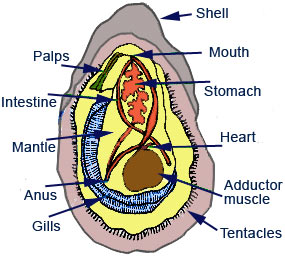

As the oyster grows in size, its shell must also grow. The mantle is an organ that produces the oyster's shell, using minerals from the oyster's food. The material created by the mantle is called nacre. Nacre lines the inside of the shell.So basically, pearls are cysts that the oysters make to protect themselves from foreign objects. Some farmers even irritate their oysters on purpose to create "cultured pearls"!
The formation of a natural pearl begins when a foreign substance slips into the oyster between the mantle and the shell, which irritates the mantle. It's kind of like the oyster getting a splinter. The oyster's natural reaction is to cover up that irritant to protect itself. The mantle covers the irritant with layers of the same nacre substance that is used to create the shell. This eventually forms a pearl.
So a pearl is a foreign substance covered with layers of nacre. Most pearls that we see in jewelry stores are nicely rounded objects, which are the most valuable ones. Not all pearls turn out so well. Some pearls form in an uneven shape -- these are called baroque pearls. Pearls, as you've probably noticed, come in a variety of various colors, including white, black, gray, red, blue and green.
Fun fact: Oysters are among the only frutti di mare that I don't eat.

Monday, August 15, 2011
Where is the Aral Sea?
Search: aral sea
Why: On reddit, TIL That the disappearing of the Aral Sea has left behind a desert filled with shipwrecks:

Muynak is a city in northern Karakalpakstan in western Uzbekistan. Home to only a few thousand residents at most, Muynak's population has been declining precipitously since the 1980s due to the recession of the Aral Sea.


But I am American and t.f. haven't looked at a world map since AP History in 12th grade.

Answer: Over here!
Source: Google Maps

The More You Know: From that page:
The Aral Sea was once the world's fourth-largest saline body of water, it has been steadily shrinking since the 1960s, after the rivers that fed it were diverted by Soviet Union irrigation projects. By 2004, the sea had shrunk to 25% of its original surface area, and a nearly fivefold increase in salinity had killed most of its natural flora and fauna. By 2007 it had declined to 10% of its original size, splitting into three separate lakes, two of which are too salty to support fish. The once prosperous fishing industry has been virtually destroyed, and former fishing towns along the original shores have become ship graveyards. With this collapse has come unemployment and economic hardship.
A Ghostwriter Speaks
PLoS ONE offers the confessions of a former medical ghostwriter: Being the Ghost in the Machine.
 The article (which is open access and short, so well worth a read) explains how Linda Logdberg became a medical writer; what excited her about the job; what she actually did; and what made her eventually give it up.
Ghostwriting of course has a bad press at the moment and it's recently been banned by some leading research centres. Ghostwriting certainly is concerning, because of what it implies about the process leading up the publication.
However, it doesn't create bad science. A bad paper is bad because of what it says, not because of who (ghost)wrote it. Real scientists can write bad papers without a ghostwriter's help.
When pharmaceutical companies pay a ghostwriter, they are not doing this to get access to special dark arts that real scientists are innocent of. As far as I can see, it's just more efficient to use a specialist writer to do your scientific sins, when you're doing it all the time.
Rather like every evil sorcerer has an apprentice to do the day-to-day work of sacrificing animals and mixing potions.
Logdberg says:
When writing a grant application, for example, you are almost literally trying to sell your proposed research to the awarding committee, on several levels. You need to sell the importance of the scientific question; the likely practical benefits of the research; the chance of success using your methods; what makes you the right person to do this work, and so on.
Writing a paper is much the same, although in this case you're selling research you've already done, and the data you collected.
Turning ugly ducklings into fundable, or publishable, swans, is part and parcel of modern science. Of course, the ducklings are not always as ugly as in the case Logdberg describes, but they are rarely as beautiful as they eventually end up.
 Logdberg, L. (2011). Being the Ghost in the Machine: A Medical Ghostwriter's Personal View PLoS Medicine, 8 (8) DOI: 10.1371/journal.pmed.1001071
 The article (which is open access and short, so well worth a read) explains how Linda Logdberg became a medical writer; what excited her about the job; what she actually did; and what made her eventually give it up.
Ghostwriting of course has a bad press at the moment and it's recently been banned by some leading research centres. Ghostwriting certainly is concerning, because of what it implies about the process leading up the publication.
However, it doesn't create bad science. A bad paper is bad because of what it says, not because of who (ghost)wrote it. Real scientists can write bad papers without a ghostwriter's help.
When pharmaceutical companies pay a ghostwriter, they are not doing this to get access to special dark arts that real scientists are innocent of. As far as I can see, it's just more efficient to use a specialist writer to do your scientific sins, when you're doing it all the time.
Rather like every evil sorcerer has an apprentice to do the day-to-day work of sacrificing animals and mixing potions.
Logdberg says:
My career came to an end over a job involving revising a manuscript supporting the use of a drug for attention deficit-hyperactivity disorder (ADHD), with a duration of action that fell between that of shorter- and longer-acting formulations.Many scientists will recall being in that kind of situation, albeit in a different context.
However, I have two children with ADHD, and I failed to see the benefit of a drug that would wear off right at suppertime, rather than a few hours before or a few hours after. Suppertime is a time in ADHD households when tempers and homework arguments are often at their worst.
...Attempts to discuss my misgivings with the [medical] contact met with the curt admonition to ‘‘just write it.’’ But perhaps because this particular disorder was so close to home, I was unwilling to turn this ugly duckling of a ‘‘me-too’’ drug into a marketable swan.
When writing a grant application, for example, you are almost literally trying to sell your proposed research to the awarding committee, on several levels. You need to sell the importance of the scientific question; the likely practical benefits of the research; the chance of success using your methods; what makes you the right person to do this work, and so on.
Writing a paper is much the same, although in this case you're selling research you've already done, and the data you collected.
Turning ugly ducklings into fundable, or publishable, swans, is part and parcel of modern science. Of course, the ducklings are not always as ugly as in the case Logdberg describes, but they are rarely as beautiful as they eventually end up.
Logdberg, L. (2011). Being the Ghost in the Machine: A Medical Ghostwriter's Personal View PLoS Medicine, 8 (8) DOI: 10.1371/journal.pmed.1001071
A Ghostwriter Speaks
PLoS ONE offers the confessions of a former medical ghostwriter: Being the Ghost in the Machine.
The article (which is open access and short, so well worth a read) explains how Linda Logdberg became a medical writer; what excited her about the job; what she actually did; and what made her eventually give it up.
Ghostwriting of course has a bad press at the moment and it's recently been banned by some leading research centres. Ghostwriting certainly is concerning, because of what it implies about the process leading up the publication.
However, it doesn't create bad science. A bad paper is bad because of what it says, not because of who (ghost)wrote it. Real scientists can write bad papers without a ghostwriter's help.
When pharmaceutical companies pay a ghostwriter, they are not doing this to get access to special dark arts that real scientists are innocent of. As far as I can see, it's just more efficient to use a specialist writer to do your scientific sins, when you're doing it all the time.
Rather like every evil sorcerer has an apprentice to do the day-to-day work of sacrificing animals and mixing potions.
Logdberg says:
When writing a grant application, for example, you are almost literally trying to sell your proposed research to the awarding committee, on several levels. You need to sell the importance of the scientific question; the likely practical benefits of the research; the chance of success using your methods; what makes you the right person to do this work, and so on.
Writing a paper is much the same, although in this case you're selling research you've already done, and the data you collected.
Turning ugly ducklings into fundable, or publishable, swans, is part and parcel of modern science. Of course, the ducklings are not always as ugly as in the case Logdberg describes, but they are rarely as beautiful as they eventually end up.
Logdberg, L. (2011). Being the Ghost in the Machine: A Medical Ghostwriter's Personal View PLoS Medicine, 8 (8) DOI: 10.1371/journal.pmed.1001071
The article (which is open access and short, so well worth a read) explains how Linda Logdberg became a medical writer; what excited her about the job; what she actually did; and what made her eventually give it up.Ghostwriting of course has a bad press at the moment and it's recently been banned by some leading research centres. Ghostwriting certainly is concerning, because of what it implies about the process leading up the publication.
However, it doesn't create bad science. A bad paper is bad because of what it says, not because of who (ghost)wrote it. Real scientists can write bad papers without a ghostwriter's help.
When pharmaceutical companies pay a ghostwriter, they are not doing this to get access to special dark arts that real scientists are innocent of. As far as I can see, it's just more efficient to use a specialist writer to do your scientific sins, when you're doing it all the time.
Rather like every evil sorcerer has an apprentice to do the day-to-day work of sacrificing animals and mixing potions.
Logdberg says:
My career came to an end over a job involving revising a manuscript supporting the use of a drug for attention deficit-hyperactivity disorder (ADHD), with a duration of action that fell between that of shorter- and longer-acting formulations.Many scientists will recall being in that kind of situation, albeit in a different context.
However, I have two children with ADHD, and I failed to see the benefit of a drug that would wear off right at suppertime, rather than a few hours before or a few hours after. Suppertime is a time in ADHD households when tempers and homework arguments are often at their worst.
...Attempts to discuss my misgivings with the [medical] contact met with the curt admonition to ‘‘just write it.’’ But perhaps because this particular disorder was so close to home, I was unwilling to turn this ugly duckling of a ‘‘me-too’’ drug into a marketable swan.
When writing a grant application, for example, you are almost literally trying to sell your proposed research to the awarding committee, on several levels. You need to sell the importance of the scientific question; the likely practical benefits of the research; the chance of success using your methods; what makes you the right person to do this work, and so on.
Writing a paper is much the same, although in this case you're selling research you've already done, and the data you collected.
Turning ugly ducklings into fundable, or publishable, swans, is part and parcel of modern science. Of course, the ducklings are not always as ugly as in the case Logdberg describes, but they are rarely as beautiful as they eventually end up.
Logdberg, L. (2011). Being the Ghost in the Machine: A Medical Ghostwriter's Personal View PLoS Medicine, 8 (8) DOI: 10.1371/journal.pmed.1001071
Friday, August 12, 2011
Debating Greenfield

British neuroscientist Susan Greenfield regrets the recent controversy over certain of her remarks, and calls for a serious debate over "mind change" -
"Mind change" is an appropriately neutral, umbrella concept encompassing the diverse issues of whether and how modern technologies may be changing the functional state of the human brain, both for good and bad.Very well, here goes. I wonder if Greenfield will reply.
As Greenfield points out, the human brain is plastic and interacts with the environment. Indeed, this is how we are able to learn and adapt to anything. Were our brains entirely unresponsive to what happens to them we would have no memory and probably no behaviour at all.
The modern world is changing your brain, in other words.
However, the same is true of every other era. The Victorian era, the Roman Empire, the invention of agriculture - human brains were never the same after those came along.
Because the brain is where behaviour happens, any change in behaviour must be accompanied by a change in the brain. By talking about how behaviour changes, we will, implicitly, also be discussing the brain.
However it doesn't work in reverse. Changes in the brain can't be assumed to mean changes in behaviour. Greenfield cites, for example, this paper which purports to show reductions in the grey matter volume of certain areas of the brain cortex in Chinese students with internet addiction compared to those without.
 The obvious comment here is that it doesn't prove causality, as it is only a correlation. Maybe the reason they got addicted was because they already had these brain changes.
However, there is a more subtle point. Even if these were a direct consequence of excessive internet use, it wouldn't mean that the internet use was changing behaviour.
We have no idea what a slight decrease in grey matter volume in the cerebellum, dorsolateral prefrontal cortex, and supplementary motor area would do to cognition and behaviour. It might not do anything.
My point here is that rather than worrying about the brain, we ought to focus on behaviour. Because that is also focussing on the brain, but it's focussing on the aspects of brain function that actually matter.
Greenfield then poses three questions.
1. Could sustained and often obsessive game-playing, in which actions have no consequences, enhance recklessness in real life?It's possible that it could, although I don't think we do live in an especially reckless society, given that crime rates are lower now than they have been for 20 years.
However, the question assumes that game playing has no consequences. Yet in-game actions do have in-game consequences. To a non-gamer, these may seem like no consequences, because they're not real.
Yet in the game, they're perfectly real, and if you spend 12 hours a day playing that game, and all your friends do as well - you are going to care about that. Those consequences will matter, to you, and with luck, you'll learn not to be so impulsive in the future.
In World of Warcraft, for example, actions have all too many consequences. If you impulsively decide to attack an enemy in the middle of a raid, you could cause a wipe, which would, quite possibly, ruin everyone's evening and get you a reputation as an oaf.
Exactly as your reputation would suffer if you and your friends went for an evening at the opera, and you stood up in the middle and shouted a profanity. Ah, but that's real life, the response goes. Is it? Is a performance in which hundreds of people sit solemnly, while grown adults dress up and pretend to be singing gods and fairies on the instructions of a deceased anti-semite, any more real than this?
3. How can young people develop empathy if they conduct relationships via a medium which does not allow them the opportunity to gain full experience of eye contact, interpret voice tone or body language, and learn how and when to give and receive hugs?I do not think that this accurately represents the experience of most children today. However, assuming that it were true, what would be the problem?
If everyone's relationships were conducted online, surely it would be more important to learn how to navigate the online world, than it would be to learn how to interpret body language, which (webcams aside), you would never see, or need to see.
If the brain is plastic and adapts to the environment, as Greenfield argues, then surely the fact that it is adapting to the information age is neither surprising nor concerning. If anything, we ought to be trying to help the process along, to make ourselves better adapted. It would be more worrying if it didn't adapt.
Some might be concerned by this. Surely, there is value in the old way of doing things, value that would be lost in the new era. Unless one can point to definite reasons why the new state of affairs is inherently worse than the old - not just different from it - it is hard to distinguish these concerns from the simple feeling of nostalgia over the past.
The same point could have equally well been made at any time in history. When our ancestors first settled down to farm crops, an early conservative might have lamented - "Young people today are growing up with no idea of how to stab a mammoth in the eye with a spear. All they know is how to plant, water and raise this new-fangled 'wheat'."
Debating Greenfield
British neuroscientist Susan Greenfield regrets the recent controversy over certain of her remarks, and calls for a serious debate over "mind change" -
"Mind change" is an appropriately neutral, umbrella concept encompassing the diverse issues of whether and how modern technologies may be changing the functional state of the human brain, both for good and bad.Very well, here goes. I wonder if Greenfield will reply.
As Greenfield points out, the human brain is plastic and interacts with the environment. Indeed, this is how we are able to learn and adapt to anything. Were our brains entirely unresponsive to what happens to them we would have no memory and probably no behaviour at all.
The modern world is changing your brain, in other words.
However, the same is true of every other era. The Victorian era, the Roman Empire, the invention of agriculture - human brains were never the same after those came along.
Because the brain is where behaviour happens, any change in behaviour must be accompanied by a change in the brain. By talking about how behaviour changes, we will, implicitly, also be discussing the brain.
However it doesn't work in reverse. Changes in the brain can't be assumed to mean changes in behaviour. Greenfield cites, for example, this paper which purports to show reductions in the grey matter volume of certain areas of the brain cortex in Chinese students with internet addiction compared to those without.
The obvious comment here is that it doesn't prove causality, as it is only a correlation. Maybe the reason they got addicted was because they already had these brain changes.However, there is a more subtle point. Even if these were a direct consequence of excessive internet use, it wouldn't mean that the internet use was changing behaviour.
We have no idea what a slight decrease in grey matter volume in the cerebellum, dorsolateral prefrontal cortex, and supplementary motor area would do to cognition and behaviour. It might not do anything.
My point here is that rather than worrying about the brain, we ought to focus on behaviour. Because that is also focussing on the brain, but it's focussing on the aspects of brain function that actually matter.
Greenfield then poses three questions.
1. Could sustained and often obsessive game-playing, in which actions have no consequences, enhance recklessness in real life?It's possible that it could, although I don't think we do live in an especially reckless society, given that crime rates are lower now than they have been for 20 years.
However, the question assumes that game playing has no consequences. Yet in-game actions do have in-game consequences. To a non-gamer, these may seem like no consequences, because they're not real.
Yet in the game, they're perfectly real, and if you spend 12 hours a day playing that game, and all your friends do as well - you are going to care about that. Those consequences will matter, to you, and with luck, you'll learn not to be so impulsive in the future.
In World of Warcraft, for example, actions have all too many consequences. If you impulsively decide to attack an enemy in the middle of a raid, you could cause a wipe, which would, quite possibly, ruin everyone's evening and get you a reputation as an oaf.
Exactly as your reputation would suffer if you and your friends went for an evening at the opera, and you stood up in the middle and shouted a profanity. Ah, but that's real life, the response goes. Is it? Is a performance in which hundreds of people sit solemnly, while grown adults dress up and pretend to be singing gods and fairies on the instructions of a deceased anti-semite, any more real than this?
3. How can young people develop empathy if they conduct relationships via a medium which does not allow them the opportunity to gain full experience of eye contact, interpret voice tone or body language, and learn how and when to give and receive hugs?I do not think that this accurately represents the experience of most children today. However, assuming that it were true, what would be the problem?
If everyone's relationships were conducted online, surely it would be more important to learn how to navigate the online world, than it would be to learn how to interpret body language, which (webcams aside), you would never see, or need to see.
If the brain is plastic and adapts to the environment, as Greenfield argues, then surely the fact that it is adapting to the information age is neither surprising nor concerning. If anything, we ought to be trying to help the process along, to make ourselves better adapted. It would be more worrying if it didn't adapt.
Some might be concerned by this. Surely, there is value in the old way of doing things, value that would be lost in the new era. Unless one can point to definite reasons why the new state of affairs is inherently worse than the old - not just different from it - it is hard to distinguish these concerns from the simple feeling of nostalgia over the past.
The same point could have equally well been made at any time in history. When our ancestors first settled down to farm crops, an early conservative might have lamented - "Young people today are growing up with no idea of how to stab a mammoth in the eye with a spear. All they know is how to plant, water and raise this new-fangled 'wheat'."
Monday, August 8, 2011
How do you remove chewing gum from glass?
Search: gum off a window
Why: I had an accident. Man, that new Mentos gum sure is sticky.
Answer: There are 4 ways!

- Use canned air. You can buy it at an office supply store to shoot dust and crumbs out of your keyboard. Blast some on the gum, and it should harden and pull right off.
- Freeze it. Rub an ice cube along the gum, holding it in place until the gum freezes and the ice cube melts. The gum should come right off.
- Zap it with bug and tar remover. Sold at auto supply stores, this stuff is designed to removed smushed bugs and tar.
- Use official gum-remover like they do at movie theaters. You can buy it at an industrial cleaning supply store.
The More You Know: Canned air comes out at -26 degrees Celsius / -14.8 degrees Fahrenheit. Here's a list of 101 Things to Do with It!

Friday, August 5, 2011
Friday, July 8, 2011
Friday, July 1, 2011
Thursday, June 30, 2011
Monday, June 6, 2011
Friday, May 6, 2011
Friday, April 22, 2011
Hardwired
By Capt. Fogg
As I've suspected, there's an increasing amount of evidence that one is born on one side of the fence or another, predestined to be what they call these days conservative or liberal. Yes, I'm very wary of these terms, since they mean what their enemies say they mean and have little to do with conserving anything real, or with the concept of reform, but still, there seem to be two kinds of minds and it's hard to account for it as merely the product of experience or study or intelligence.
Yes, I've joked about the far right not having a sense of humor that differs from meanness and I can think of all kinds of nominally liberal reformers who would crumble if they ever smiled, but that impression isn't unique to me and I find it compelling. Some people find their view of reality far too serious, too dangerous, and threatening to find much to laugh about, unless it's to laugh about the discomfiture and humiliation of an enemy.
That there are indeed two kinds of minds, two predispositions toward political, religious, and sociological poles, is compelling, not that I would suggest using any evidence for it to dismiss arguments from either side. Sometimes, conservative is actually conservative and liberal is just liberal and the truth may be neutral.
There may be important evidence for physical differences between those who feel threatened, respond to perceived threats with more aggression, more disgust and less tolerance for uncertainty. A taste for strongly held credos about morality and politics almost defines such people and we usually call them conservatives. A distaste for absolute moral judgments, for saying something is "just wrong" without considering the results, defines those we want to call liberals.
"Liberal Brains" seem more tolerant of uncertainty than conservatives according to a study of brain scans of 90 volunteers at University College London. Brain scans revealed, or so it's claimed, physical differences:
Previously, some psychological traits were known to be predictive of an individual's political orientation... Our study now links such personality traits with specific brain structure,
says researcher Ryota Kanai.
People with a large amygdala are "more sensitive to disgust" and tend to "respond to threatening situations with more aggression than do liberals and are more sensitive to threatening facial expressions," the study said.
Liberals are linked to larger anterior cingulate cortexes, a region that "monitor(s) uncertainty and conflicts," it said.
So is this cause or effect? Are these findings real? Maybe it's too soon to tell and I can certainly identify some traits that would make me more conservative than the stereotypical liberal. What I am is for others to say, but I certainly find fault in many standard liberal shibboleths, even if I'm intolerant of certainty, and that includes being certain that the study means anything.
Our findings are consistent with the proposal that political orientation is associated with psychological processes for managing fear and uncertainty,
says the report, and that feels right, even if many wrong things feel right. I'm just not afraid of the conservative bogeymen like net neutrality, graduated income tax, single-payer health programs or Social Security. I am, however, concerned about the danger of inflexible creeds that seem to need a great deal of misplaced faith to follow and a government that follows such things without regard to the will of the electorate, the lessons of history, or even the demands of common decency. I believe in uncertainty.
So is my anterior cingulate cortex bigger or smaller and does size matter? It's not as though I'm free of fear, I just fear the fearful and the things they do.
(Cross-posted from Human Voices.)
Friday, April 15, 2011
Wednesday, March 23, 2011
God is dying: Reflections on science, religion, and the human spirit
Over at Cosmic Variance, a blog at Discover, Sean Carroll has a really interesting post up on whether the universe needs God. I recommend reading it in its entirety, but here's a taste:
Over the past five hundred years, the progress of science has worked to strip away God's roles in the world. He isn't needed to keep things moving, or to develop the complexity of living creatures, or to account for the existence of the universe. Perhaps the greatest triumph of the scientific revolution has been in the realm of methodology. Control groups, double-blind experiments, an insistence on precise and testable predictions – a suite of techniques constructed to guard against the very human tendency to see things that aren't there. There is no control group for the universe, but in our attempts to explain it we should aim for a similar level of rigor. If and when cosmologists develop a successful scientific understanding of the origin of the universe, we will be left with a picture in which there is no place for God to act – if he does (e.g., through subtle influences on quantum-mechanical transitions or the progress of evolution), it is only in ways that are unnecessary and imperceptible. We can't be sure that a fully naturalist understanding of cosmology is forthcoming, but at the same time there is no reason to doubt it. Two thousand years ago, it was perfectly reasonable to invoke God as an explanation for natural phenomena; now, we can do much better.
None of this amounts to a "proof" that God doesn't exist, of course. Such a proof is not forthcoming; science isn’t in the business of proving things. Rather, science judges the merits of competing models in terms of their simplicity, clarity, comprehensiveness, and fit to the data. Unsuccessful theories are never disproven, as we can always concoct elaborate schemes to save the phenomena; they just fade away as better theories gain acceptance. Attempting to explain the natural world by appealing to God is, by scientific standards, not a very successful theory. The fact that we humans have been able to understand so much about how the natural world works, in our incredibly limited region of space over a remarkably short period of time, is a triumph of the human spirit, one in which we can all be justifiably proud.
This isn't necessarily new to those of us who look to science instead of some mythological faith to answer our questions, including our existential ones, and to provide a comprehensive picture of our world, but it's well put and bears repeating at a time when science is under fire from the right and when religiously-rooted ignorance continues to threaten progress towards greater enlightenment.
I've always described myself as an agnostic as opposed to an atheist but that's only because I recognize that we don't have all the answers. (Okay, I also describe myself as a nihilist, but that's more philosophical, and I do tend to recoil from all-out Nietzscheanism. It's hard to be a nihilist and also a progressive liberal who tries to advance the cause of freedom and human dignity.) And I think such doubt with respect to absolutism, with respect to any claim to absolute certainty, to the Truth, is healthy. (Nothing has all the answers, and if you think you have them, or believe in something that has them, you're wrong. About that I am absolutely certain.) Indeed, I think such doubt is also what drives my appreciation for science, which, by the way, does not claim to have all the answers and which, contrary to, say, Christianity, is about recognizing that there's a lot we just know and that only through further investigation can we ever know more.
Saturday, January 29, 2011
Craziest Republican of the Day: Jack Kingston
The Republican Party is indeed the anti-science party, and Steve Benen today offers yet more evidence of that:
"Real Time" host Bill Maher asked Rep. Jack Kingston (R-Ga.) a fairly straightforward question: "Do you believe in evolution?" Kingston not only said rejects the foundation of modern biology, he explained it this way: "I believe I came from God, not from a monkey." He added, "If it happened over millions and millions of years, there should be lots of fossil evidence."
Seriously, that's what he said.
Let's pause to appreciate the fact that it's the 21st century -- and Jack Kingston is a 10-term congressman who helps oversee federal funding on the Food and Drug Administration.
*****
In the larger context, there's a renewed push underway for the United States to value and appreciate science in the 21st century -- our future depends on it. And while this push is underway, Republican leaders are more comfortable walking a bridge to the 18th century.
What an embarrassment.
It's an embarrassment, yes, but Steve is actually being too kind. They're not walking a bridge to the 18th century, a century of Enlightenment, but so, oh, say, the 14th, before even the Renaissance got underway.
Of course, when it comes to evolution, and the denial thereof, we've heard all this before (including from Christine O'Donnell last year). But that's only because such views are commonplace among conservatives and widespread within the GOP, where creationism is almost as big as voodoo economics.
And, again, what's concerning is not so much that these views exist but that they are very much a part of the Republican mainstream. It would be one thing if such willful ignorance, rooted in Christian fundamentalism, were merely to be found on the distant far-right fringe. It's another thing entirely that such crazy extremism dominates the majority party in the House.
Here's the clip:
Thursday, December 30, 2010
Why conservatives are scared shitless
Check out this interesting piece at The Raw Story:
Political opinions are considered choices, and in Western democracies the right to choose one's opinions -- freedom of conscience -- is considered sacrosanct.
But recent studies suggest that our brains and genes may be a major determining factor in the views we hold.
A study at University College London in the UK has found that conservatives' brains have larger amygdalas than the brains of liberals. Amygdalas are responsible for fear and other "primitive" emotions. At the same time, conservatives' brains were also found to have a smaller anterior cingulate -- the part of the brain responsible for courage and optimism.
If the study is confirmed, it could give us the first medical explanation for why conservatives tend to be more receptive to threats of terrorism, for example, than liberals. And it may help to explain why conservatives like to plan based on the worst-case scenario, while liberals tend towards rosier outlooks.
"It is very significant because it does suggest there is something about political attitudes that are either encoded in our brain structure through our experience or that our brain structure in some way determines or results in our political attitudes," Geraint Rees, the neurologist who carried out the study, told the media.
Not that we really needed a study to tell us that conservatives are "primitive," but it's helpful to have this sort of scientific confirmation.
Subscribe to:
Posts (Atom)


